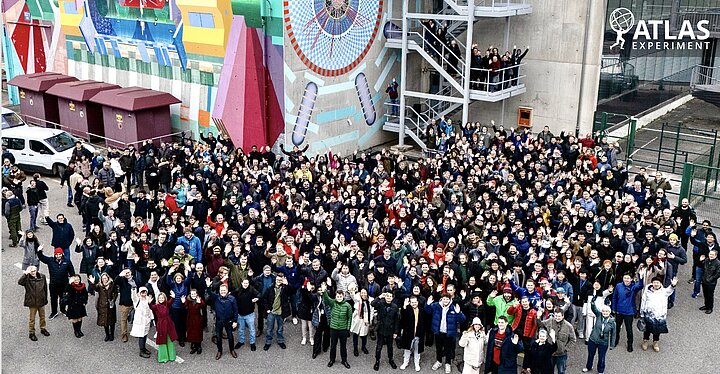
The goal of the ATLAS experiment is to investigate fundamental components of matter and their interactions by colliding particles of very high energy in the LHC (Large Hadron Collider) accelerator at CERN. Collection of physical data started in 2009. Since then the LHC delivered proton beams colliding at energy of 900 GeV, 7,8, 13, and 13.6 TeV with steadily increasing luminosity reaching the value two orders of magnitude higher compared to luminosity ever reached in another accelerator. In addition to proton collisions, the LHC brings in collisions heavy ions for four weeks per year on average. Over time the energy of these collisions also increased from 2.76, 5.02, and 5.36 TeV/nucleon pair.
The scientific program of the ATLAS experiment, which is foreseen to take about 30 years, comprises measurements aiming to provide experimental input to fundamental problems related to understanding the nature of the matter. The main goals of the experiment are:
- existence and properties of Higgs boson particle, which is a carrier of field responsible for spontaneous symmetry breaking and for the mass of particles,
- search for supersymmetric particles and expected symmetry between fermions and bosons,
- investigation of the quark-gluon plasma state of the matter,
- unification of fundamental interactions beyond the standard model,
- and verification of concepts of additional dimensions of space.
Given the very high luminosity of the LHC, it was necessary to develop new types of detectors based on high-end technologies for the ATLAS experiment. New challenges that were practically absent in the past particle physics experiments are due to radiation damages in the detectors and in the readout electronics. This applies in particular to the tracking detector, which is mostly based on silicon technologies. The team from the Faculty of Physics and Applied Computer Science of the AGH University of Krakow participates in development of new detector technologies, building and commissioning the detector from the very beginning, i.e. since 1996. This activity is carried out in a close collaboration with the Institute of Nuclear Physics of the Polish Academy of Sciences. The team contributed to these major tasks:
- development of radiation resistant integrated circuits for readout of silicon strip detectors in the SCT (Semiconductor Tracker) detector,
- development of the concept and building of the gas gain control system for the TRT (Transition Radiation Tracker) detector,
- design and production of the high voltage power supply system for biasing the SCT - this task has been realised together with the Institute of Nuclear Physics,
- development of HLT (High Level Trigger) steering software,
- study of electron and photon performance in the HLT and offline reconstruction,
- trigger configuration and performance for lead-lead collisions,
- study of the quark-gluon plasma (QGP) with hard probes (electroweak bosons, top quarks) in heavy-ion collisions,
- study of soft physics phenomena in heavy-ion collisions and small systems,
- study of physics of ultra-peripheral collisions of lead-lead ions,
- study of diffractive physics with forward detectors.
In parallel with data taking at the LHC in years 2022-2025, an upgrade program has been started towards the high luminosity LHC (HL-LHC) aiming at increasing the luminosity by a factor 10. To operate in such conditions, the ATLAS detector requires major upgrades. In particular, a completely new Inner Tracker (ITk) is being built at the moment to start operations in 2029. The team from the Faculty of Physics and Applied Computer Science already actively participates in development of the ITk and advanced technologies required for the new detector. To benefit from HL-LHC a data processing capacity of the ATLAS experiment needs to increase 10 fold. Among various areas where significant advancements need to take place is online data filtering. Researchers from the AGH ATLAS group contribute to this part of the project.